Grade 9 – Keep Learning, Keep Planning, Shape the Future


This week was once again intensive, varied and productive for Grade 9. Between systems of equations, population development, the Bundestag and ecosystems, the students discussed, calculated, researched and presented. At the same time, the future was a recurring theme: job interviews, the French future tense, our Germany trip – and ideas through which the students can make a difference themselves.
Our Student Company – developing ideas and taking responsibility
Our student company continued to play an important role in everyday school life. The class collected ideas, discussed possibilities and considered how creative projects could enrich school life while also generating funds for shared activities and goals.
Along the way, the students are developing valuable skills: taking responsibility, thinking economically, making decisions together and working effectively as a team.
Germany Trip 2027 – plans are becoming reality
Another important milestone has been reached in the planning of our Germany trip: the flights are now officially booked.
From 4 to 23 April 2027, the class will travel together through Germany. Alongside school-based and professional insights, the students can look forward to many encounters and a wide range of new experiences.
Excitement is growing – and at the same time, the students are already discovering just how much organisation, responsibility and teamwork are involved in planning such a journey.
Mathematics – making equations visible
In Mathematics, the class worked intensively on systems of linear equations and learned to use different algebraic and graphical methods to solve them.
A particular focus was placed on graphical solutions. Using digital learning tools, the students were able to visualise equations, identify points of intersection and check their results.
In this way, mathematics was not only calculated but also made visible and easier to understand.
At the same time, the class is gradually preparing for the next test.
Geography – how does a population grow?
In Geography, the unit on world population and population development continued, with Ghana repeatedly serving as a concrete case study.
The students first examined how unevenly population can be distributed within a country. A comparison between Greater Accra and the far more sparsely populated Savannah Region clearly showed that population distribution is anything but uniform.
The class then explored the concept of population balance. Births, deaths, immigration and emigration all influence whether and how quickly a population grows or declines.
A particularly interesting comparison was made between Ghana and Germany. Different birth and death rates demonstrated how differently population development can unfold – and why individual figures always need to be considered within a wider context.
Using Ghanaian census data, the students then analysed the country’s long-term population development: from around 6.7 million inhabitants in 1960 to approximately 30.8 million in 2021. They created their own graphs, described the development and formulated further questions.
This work also provides the foundation for the next step in the unit: the demographic transition model.
Ethics – safety through AI or digital surveillance?
A highly topical question was at the centre of Ethics this week:
Should artificial intelligence be used to monitor student behaviour in order to prevent violence or bullying?
What made the lesson particularly special was that two students took responsibility for preparing and moderating the session themselves. They asked critical questions, structured the discussion and ensured that different viewpoints were heard.
Digital tools, including the Fobizz board and interactive polling tools, supported the discussion. Afterwards, the students carried out their own research and also used AI applications to check arguments and explore further perspectives.
It quickly became clear that there is no simple answer: safety, data protection, privacy and responsibility all need to be carefully balanced.
German – “Why should we hire you?”
This is a question our students may soon encounter in real life. That is why German lessons this week focused on job interviews.
The class explored typical interview questions, developed convincing answers and reflected on their own strengths and abilities. More challenging questions were included as well – after all, “Because I need a job!” may not be the strongest possible response to “Why should we hire you?”
The students then looked more closely at appearance, clothing and body language. How important are eye contact and a friendly greeting? What comes across as professional? And why might swimwear perhaps not be the ideal choice for a job interview?
Checklists, a real job advertisement and prepared role plays made the training as practical as possible. The students took turns acting as applicants, members of a recruitment team and observers, while also giving one another constructive feedback.
The conclusion: good preparation is half the battle – and “I have no idea!” is rarely the most convincing answer to a difficult question.
Social Studies – the heart of German democracy
In Social Studies, the German Bundestag was at the centre of attention.
The students learned about its composition and its main responsibilities while also revisiting and applying important key terms from the previous week.
They also explored which offices are elected within the Bundestag and how someone becomes a Member of Parliament in the first place.
Step by step, abstract political concepts therefore developed into a clearer understanding of how parliamentary democracy in Germany works.
Biology – from biotope to ecosystem
In Biology, the students first had to distinguish clearly between three important terms: biotope, biocenosis and ecosystem.
They discovered that an ecosystem consists not only of a habitat or a community of living organisms, but of the many interactions between them.
The class also explored why ecosystems can be described as open and dynamic. Matter and energy are exchanged, conditions change, and organisms constantly respond to one another and to their environment.
An ecosystem is therefore never completely static.
French – the future has its own tense
In French, Grade 9 looked ahead linguistically and explored the futur simple.
The students learned how this important tense is formed and how it can be used to express future plans, intentions and predictions.
Through a range of activities, they practised putting verbs into the future tense and creating sentences about what they will do, where they will go and what the future might bring.
Grammar was therefore connected directly to real-life situations – because the future is full of possibilities, and Grade 9 is now learning how to talk about them en français.
English – discussing literature instead of simply reading it
English lessons began with a small surprise: our intern Maimon had brought back some treats from his short trip to Germany, which the students greatly appreciated.
After that, the focus shifted to literature. The students prepared their book forum on Octavia Butler’s “Kindred”. Grade 8 formed the audience, while teachers also joined as guests.
During the forum, the students shared their thoughts on the novel, discussed key themes and responded to questions from the audience.
The task therefore went far beyond simply reading the book. The students had to interpret the text more deeply, communicate their ideas clearly, respond to different perspectives and speak confidently about literature in front of an audience.
It was an intensive week – and one in which Grade 9 looked towards the future in many different ways: linguistically, professionally, socially and very concretely as preparations continue for the journey to Germany.
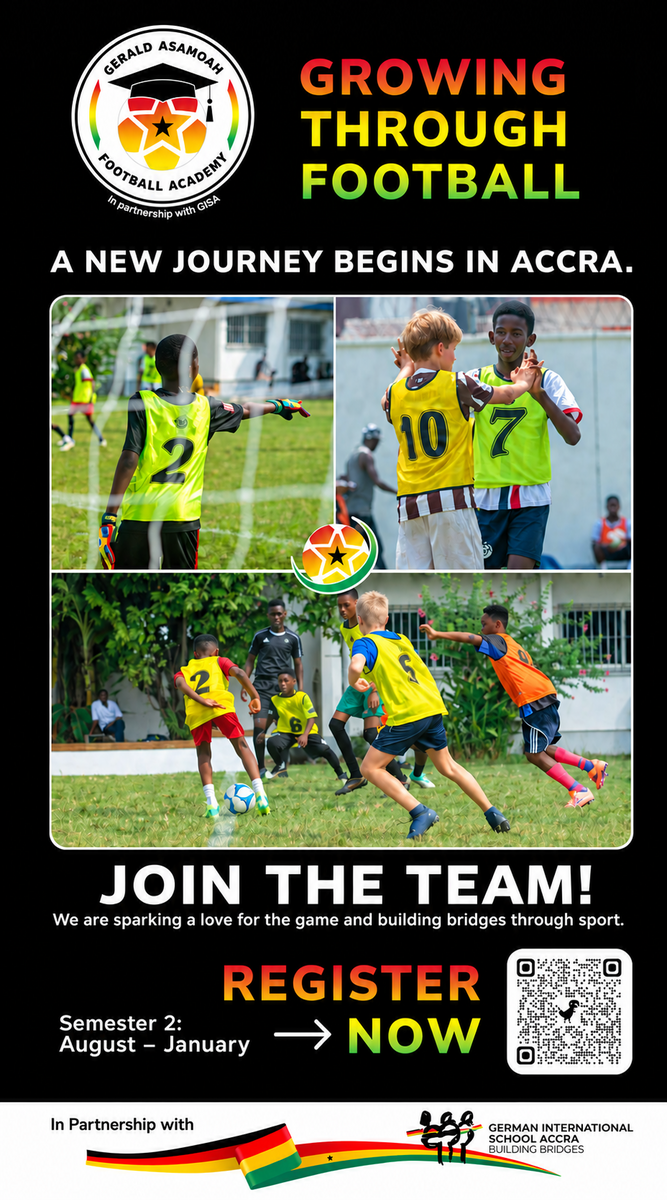
⚽Gerald Asamoah Football Academy
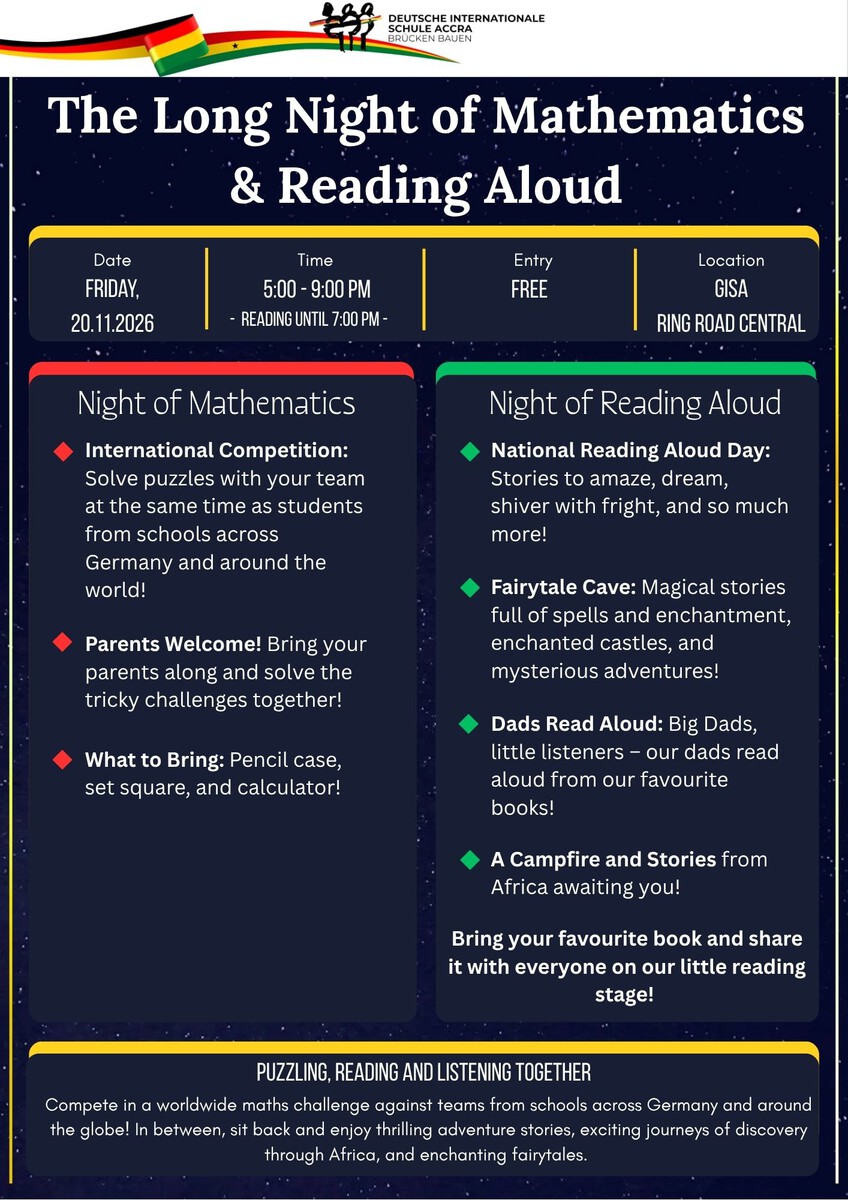
The Long Night of Mathematics & Reading Aloud
Christmas Market

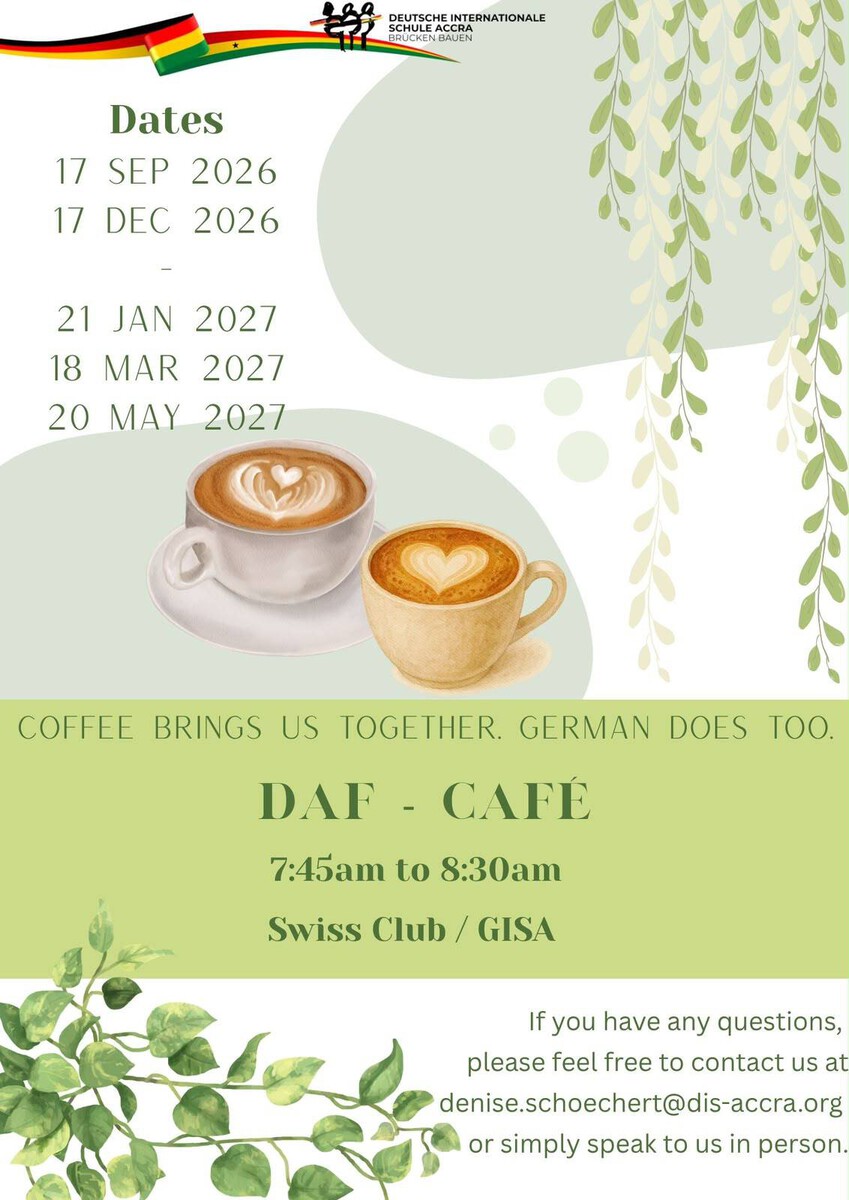
☕ DaF Café: Speaking German and Connecting Through Conversation
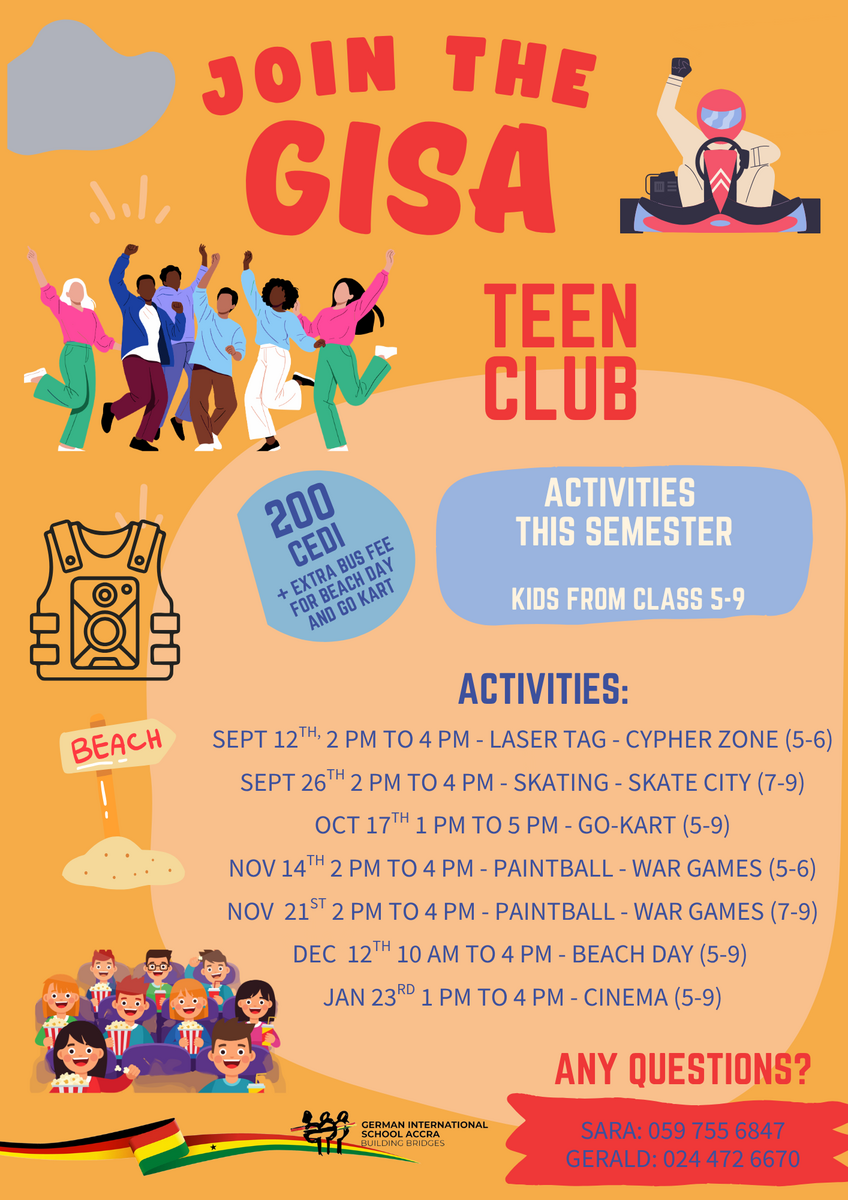
GISA Teen Club