Newsletter 11.09.2026


Having a say, trying things out, arguing a point and taking responsibility – these ideas ran like a common thread through our week. Class 4 turned a very concrete playground issue into a democratic project, Classes 5 and 6 experienced a citizens’ assembly in ancient Athens, Classes 7 and 8 negotiated medieval power structures through role play, and Class 9 explored the dynamics of the First World War through a strategy game.
At the same time, this week once again showed how much schools benefit from encounters and fresh perspectives. Our intern Benno Gerks taught his own lesson, our students discussed, experimented and created – and in the coming days, representatives from school leadership, administration and the Board will represent GISA at the Regional Network Meeting in Cairo.
From our school community
GISA at the Regional Network Meeting in Cairo
From 14 to 16 September, GISA will take part in the Regional Network Meeting of German Schools Abroad in Region J at DEO Cairo. The focus of this year’s meeting is the purposeful use of AI in teaching, administration and school development.
Representing GISA in Cairo will be Headmaster Rainer Kropp-Kurta, our designated new Head of Administration Ada Kulakowska-Harrak, and Beatrice Thiel on behalf of the Board. In addition to professional exchange and best-practice examples, the programme includes the development of school-specific AI approaches and AI roadmaps.
Fresh ideas from Potsdam: Benno Gerks at GISA
 Our intern Benno Gerks from the University of Potsdam taught his own lesson in Class 9 on the “Christmas Truce of 1914” and impressed with his careful preparation, clear teacher language and calm presence.
Internships like this are valuable for everyone involved: students bring new academic and didactic ideas, take on responsibility and gain important practical experience – while our students and staff benefit from fresh perspectives and additional support.
➡️ Read more: Fresh ideas from Potsdam – Benno Gerks enriches GISA
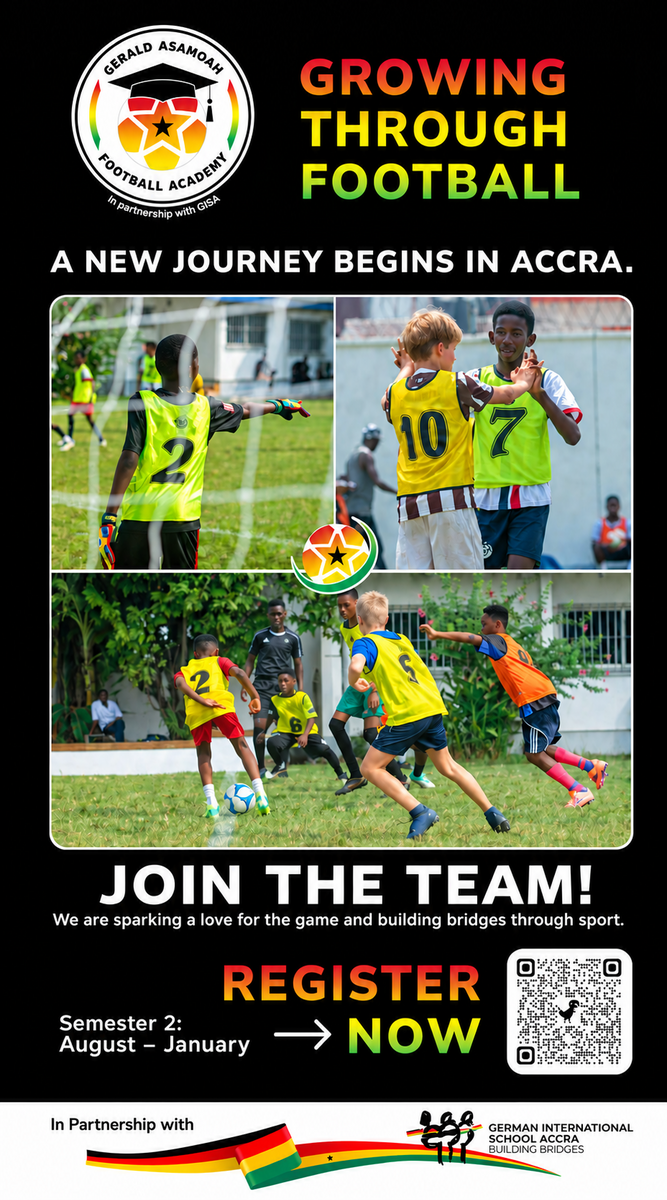
Creative competition for our Football Academy
 The door to the equipment room of our Football Academy is getting a new look – and we are looking for ideas from our students. We are inviting creative designs around football, team spirit, school and community. Entries can be submitted to Steffi Weber until 23 September.
➡️ Read more: Together. Creative. Strong.
German Language Day 2026
 On 31 October, the German International School Accra will once again become a meeting place for German language, culture, education and German-Ghanaian exchange. Under the motto “German connects: From language to opportunities”, visitors can look forward to presentations, interactive activities, music, culture and insights into educational and future opportunities – together with our Team Germany partners.
➡️ Read more: German Language Day 2026 – German connects: From language to opportunities
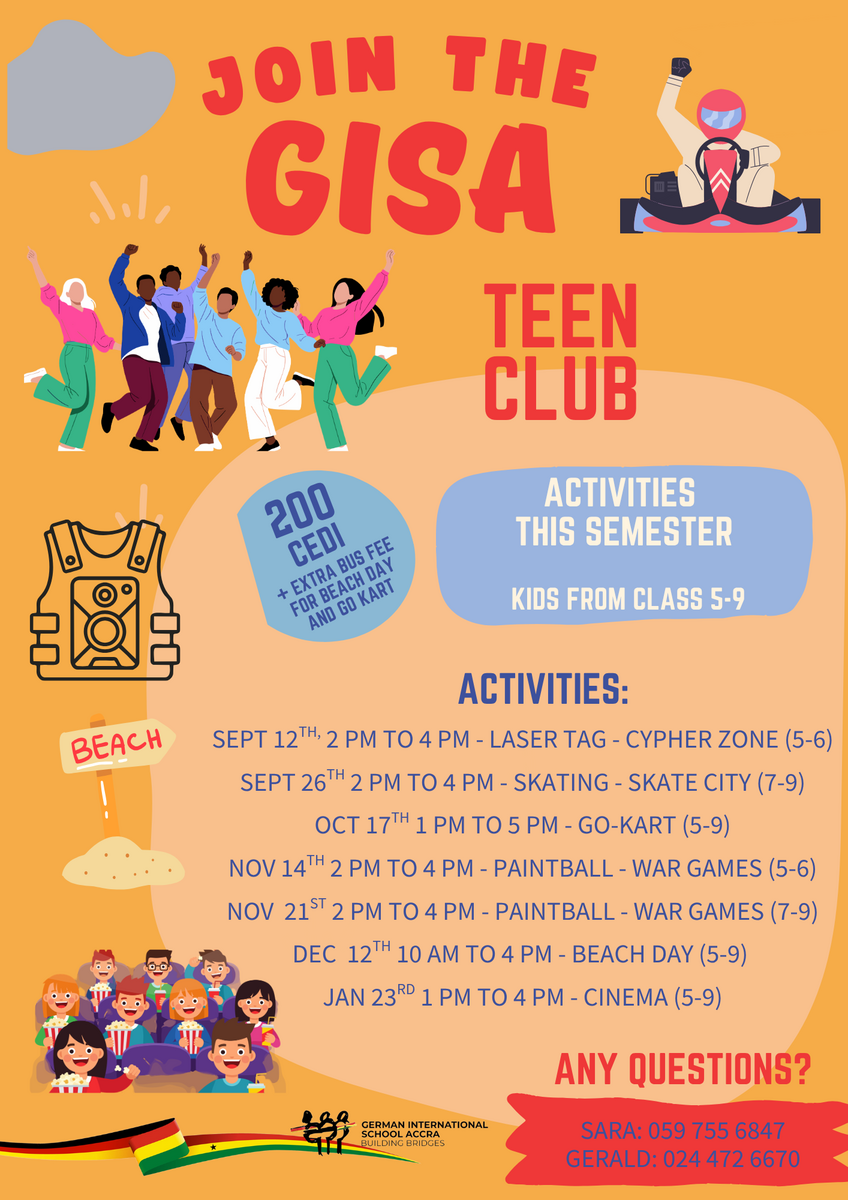
Teen Club Classes 5/6: Laser tag at Cypher Zone
On Saturday, 12 September, the Teen Club for Classes 5 and 6 will meet from 2:00 to 4:00 p.m. at Cypher Zone in Palace Mall Labone. An afternoon of laser tag and other games is planned.
Important notice: Founder’s Day
Monday, 21 September, is Founder’s Day. There will be no classes on this day.
We wish all our families an enjoyable holiday.
Professional Development Day on 25 September
Friday, 25 September, will be a Professional Development Day at GISA. There will be no regular classes on this day. Our staff will use the day for professional learning, educational development and work on key school development priorities.
Emergency childcare will be available for families who need it. Please register your child with the respective class teacher by Friday, 18 September.
Emergency childcare will also be available for Kindergarten children on this day. Please register your child with the Child Care Center management by Friday, 18 September.
Unfortunately, we are unable to offer childcare for Nursery children. Due to the particularly close relationship they have with their key caregivers, Nursery children need familiar and consistent support. This level of continuity cannot be guaranteed by other childcare staff on this day.
We kindly ask for your understanding and thank you for supporting us in the planning of the Professional Development Day.
Newsletter notice
Due to the upcoming events and activities, the next GISA newsletter will not be published until 24 September 2026. Until then, we will continue to share important current information and dates through our usual communication channels.
From the Nursery
Feelings, movement and a new face
 This week, the Nursery focused on the topic “My Feelings”. Using emotion stones, the children explored different feelings, learned to name them and expressed them through play.
We also celebrated another birthday with circle games, songs, “Happy Birthday” and delicious banana bread.
With the start of our afternoon activities, the children had their first opportunity to try baby yoga, combining simple stretching and relaxation exercises with body awareness and movement.
We are also delighted to welcome a new child to our Nursery group and wish them a wonderful start and a smooth settling-in period.
From Kindergarten
Autumn atmosphere and lots of movement


 After the first leaves began falling from the trees in our garden, autumn made its way into Kindergarten this week. The children created autumn crafts, sang new seasonal songs and discovered poems to match the theme.
Our regular activities also continued as usual. Taekwondo was once again particularly popular and gave the children plenty of opportunities to move with energy and enthusiasm.
The week ended on an especially active note on Friday. During our Sports Day on the large football field, the children explored different movement stations – from jumping on the trampoline and balancing through a small course to trying out new movement games.
A warm welcome to Sandra!
 From 15 September, Sandra Smart Mensah will join our Child Care Center team and will work mainly in Kindergarten. Sandra is currently training in Montessori and Early Childhood Education. She is particularly interested in supporting children in developing independence, social skills and self-confidence.
We are very happy to welcome Sandra to GISA and wish her a great start and many valuable experiences with us.
A journey around the world – movement connects!
 On Tuesday, 15 September, we invite our Kindergarten children and one parent to a special afternoon of movement. From 3:30 to 4:30 p.m. on the GISA football field, the focus will be on movement, fun and enjoying an active experience together.
Registration is through the lists displayed at the group doors. Participation is limited to 15 children.
From the Primary School
Class 1/2: Reading, calculating, exploring and creating
In Class 1, the letter S was introduced. The children practised syllables and words using the letters they already know. In Class 2, a variety of reading exercises helped the children further develop both reading comprehension and reading fluency.
In Mathematics, Class 2 continued working with the hundred chart. These are also easy questions to practise at home: “Which number lives below 75?” or “I start at 25 and move three steps to the right. Where do I land?” Class 1 continued working on writing numerals and matching quantities to numbers.

 In General Studies, the children completed their posters about pets. They produced some wonderful results and proudly presented their work.
In Art, the sound of “Quack, quack, quack …” could be heard this week. Through the Kamishibai story “Quak and the painter Monet”, the children travelled to Monet’s garden and discovered how water can appear in different colours depending on the light and how Monet created his paintings using many small dabs of colour. The children began their own artwork with a blue background. Next week, the colourful dabs will follow.
Many children also used the Anton App. Some have already received their personal code in their home-school folder so that they can continue working with the assigned content at home.
Class 3: Exploring language, calculating, reading and creating
In German, we have spent the past few weeks taking a closer look at the German language. Using our “verb tree”, the children explored infinitives, verb stems and different personal forms. This week, they consolidated their learning through a variety of challenges and games, enthusiastically practising how to identify and categorise different parts of speech – while collecting plenty of marbles for their class marble jars.


In Mathematics, our mathematical word bank took centre stage. The terms add, subtract, sum and difference were revised and actively applied while solving challenging number puzzles.
English also offered exciting insights into the world of literature. A special highlight was a surprise from Miss Mayoga: every child received their own bookmark. Perhaps ask your child at home what special meaning lies behind it!
In Ethics, we began a new unit on “Feelings”. The children collected different emotions they already knew and then acted them out using plenty of expression and movement.
After intensive breaststroke practice, Swimming offered a chance to simply enjoy the water with swimming cushions and pool noodles.


In Art, the journey of our name aliens continued. Having left Pluto behind, the children worked in groups to design a new home, complete with their own landscapes, colours and special places. The first fantastic planets are already beginning to take shape.
Class 4: Calculating, reading, creating and making decisions together
In Mathematics, the children successfully completed semi-written multiplication and continue to practise their multiplication tables and division facts. Step by step, they then moved on to semi-written division. After beginning with two-digit numbers, they are now already tackling three-digit numbers. To finish, the children worked in small groups on particularly challenging division problems and supported one another in finding suitable strategies.


In German, nouns were once again a central focus, this time with particular attention to forming plurals. The children also looked up verbs in the dictionary and strengthened their dictionary skills. In reading, they explored different reading strategies, especially those that can help before actually beginning a text. During individual reading activities, some children worked with books of their own choice, while others solved reading puzzles at different levels of difficulty.
In English, Class 4 entered a new phase in reading and writing. After three weeks of intensive work on important foundations – particularly punctuation – Miss Mayoga surprised the children with a zebra bookmark. The black stripes represent reading and the white stripes writing, encouraging the students to continue developing both areas throughout the school year.


In Art, the learning booths received their final details and finishing touches. What were once simple wooden structures have become colourful, individual workspaces. The paintbrushes can now finally be put aside and the booths can begin serving their real purpose: focused and undisturbed learning. Whether Mathematics problems might now almost solve themselves inside them remains to be tested.
Reports of difficulties and conflicts when using the jumping mat also developed into a cross-curricular project. During class council, the children first collected possible solutions. In Ethics, they then developed a survey for all students who use the jumping mat. In German, the survey was prepared and introduced to the other classes. Linking this with the current topic of democracy in General Studies, the results were finally evaluated and discussed together. In this way, the children experienced very practically how opinions can be gathered and decisions made democratically.
From the Secondary School
Class 5: Big numbers, world maps, friendship and democracy
 In Mathematics, we worked intensively with the number line and gradually extended our number range. Things became especially interesting when we reached very large numbers: million, billion, trillion and quadrillion were explored using place-value charts. This clearly demonstrated just how important the position of a digit is in determining the value of a number.
In Geography, we once again began with the question: Which is bigger – Africa or Greenland? Using the Equal Earth map, we discussed how maps can influence the way we perceive the world. We then explored the Equator, Prime Meridian, longitude and latitude, as well as the role coordinates play in orientation.
In Ethics, our topic was friendship. In a shared mind map, the students collected ideas about what friendship means to them – from trust and honesty to shared experiences, mutual support and respect.
In History, democracy in ancient Athens took centre stage. In a simulated citizens’ assembly, students had to decide whether Athens should spend its money on new warships or public fountains. One thing quickly became clear: not everyone was allowed to have a say.
 In English, work continued on the students’ own fables. They read their texts to one another and gave peer feedback. Two students took on the role of a jury and moderated the feedback. The class then began digitally designing their fables using PowerPoint or Canva. Work will continue next week before the finished pieces are presented.
In Art, Classes 5 and 6 continued following in the footsteps of Keith Haring. Figures were refined, lines strengthened and, finally, bold colours were added. The jumping, dancing and tumbling figures are becoming more lively with every step.
Class 6: Geometry, democracy, Art and Biology
In Mathematics, we completed our first Geometry topic and worked on drawing oblique sketches of three-dimensional shapes. At the same time, our Mathematics plan work helps the students improve their pace, independence and organisation of their own learning. Regular multiplication-table practice is also preparing us for the upcoming topics of divisibility and fractions.
In History, we took a closer look at democracy in ancient Athens. During their own citizens’ assembly, the students experienced how political decisions were made – and who was excluded from taking part. Women, metics and enslaved people were not allowed to participate. This provides a good foundation for our next exciting question: How differently did Sparta work?
In Art, Classes 5 and 6 continued following in the footsteps of Keith Haring. The first designs were refined, lines strengthened and bold colours finally came into play. Our jumping, dancing and tumbling figures are becoming increasingly lively – although the artworks are not quite finished yet.
In Biology, the e-books have now been set up for almost all students. The German mother-tongue group has already begun describing the characteristics of living things and classifying animals into different groups. The topic of evolution sparked particular interest.
Class 7: Debates, decimals and medieval power games
 “For or against?” was once again the question in German this week. After recently looking closely at “School with or without grades?” and even surveying the school community, it was time to get debating. One rule still applies: simply saying “That’s just what I think!” is no longer enough – we need claims, reasons and examples. Things became particularly interesting with a topic very close to everyday school life: Does GISA need a school kiosk? Together with Class 8, we discussed whether and how such a kiosk could work. What should be sold? Who could run it? And, of course, perhaps the most important question of all: What would there be to eat during break? Many strong arguments and fresh ideas later, one thing is clear: Class 7 can now not only have an opinion – they can defend it pretty convincingly too.
From arguments to numbers: Mathematics focused on multiplying and dividing rational numbers. Whether decimals or fractions – everything was included. The main challenge was applying the calculation rules accurately and keeping a close eye on the signs. After all, one small minus sign can make quite a big difference.
 In Geography, we began with a seemingly simple question: Which is bigger – Africa or Greenland? The surprising size comparison showed us how strongly maps can influence our perception. Using the Equal Earth map, we examined different representations of our planet. Postcards from different climate zones then took us on a journey around the world before a breakout activity playfully revised polar day and polar night, climate zones and atlas skills. Next stop: the climate zones of our planet.
History took us on a journey to a very different time. A king, nobles, a bishop and knights had to negotiate land, protection, loyalty and military service. In the strategy game “Feudalism Live”, Class 7 experienced first-hand why a medieval king could not simply say, “I’m the king, so everyone does what I say!” Without allies and clever negotiation, very little happened.
Very different forces were at work in Physics. We continued exploring “Forces” and learned what happens when several forces act in the same or opposite directions. Now we know: sometimes you add them, sometimes you subtract them – Physics can be surprisingly mathematical.
Chemistry, meanwhile, became dangerous – at least on paper. We explored different hazard pictograms and can now identify what dangers a substance may pose and which safety measures are required. Flames, skulls and other symbols are no longer mysterious images but important warnings in the laboratory.
There was plenty of research in Biology as well. Together with the German mother-tongue students from Class 8, we continued studying invertebrates. Once the presentation topics had been assigned, work began immediately. The first results already look very promising, and next week the students will continue researching, designing and preparing.
 In French, we revisited useful vocabulary connected with la rentrée – the start of the school year. We practised different ways of talking about the beginning of school and expressing feelings, opinions and thoughts about it. To finish, the new knowledge was tested playfully on the online platform Wayground. A little French, a little reflection and a digital challenge – pas mal.
From knowing to doing: in Ethics, we selected our personal top five from the 15 values in our “treasure chest of values”. But considering respect, helpfulness or honesty important is not enough – they also need to be lived. Each student therefore selected one value to put consciously into practice this week: How, when, where and with whom? What do I need? And how will I know whether my mission was successful? Values became concrete actions – to be continued ...
Social Studies is also increasingly moving from reflection towards action. In our “Chance for Children” project workshop, the project teams explored the NGO’s different areas of work in greater detail. They researched and discussed: What does CfC do? Where is support needed? And what could we as a class contribute? At the same time, we are collecting questions for our first meeting with the CfC team. Our goal is not simply to talk about engagement, but to develop ideas that can genuinely make a difference.
And after all that thinking, movement certainly could not be missing. In PE, different tag games tested reaction speed and running skills. A game of rounders with not one but two “burners” added tactical decision-making – including one or two spectacular runs.
So this week took us through debates and decimals, maps and values, forces and hazard symbols, French and invertebrates, medieval power games and sporting sprints. In short: standing still was not an option for Class 7 – either mentally or physically.
Class 8: Experimenting, arguing and experiencing power
Mathematics focused this week on multiplying sums. At the same time, the students continued practising and consolidating the rules for transforming algebraic expressions.
In Chemistry, the class explored different types of mixtures and learned to distinguish between homogeneous and heterogeneous mixtures. Experiments will now help the students investigate these mixtures more closely and apply their new knowledge in practice.
Physics turned to the topic of forces. The students learned how forces acting in the same direction or in opposite directions can be combined and calculated.
In Biology, the class continued working on invertebrates together with Class 7. After the presentation topics had been assigned, the students began researching and preparing their presentations. The first results already look very promising.
French continued with the passé composé. The focus was on the 17 verbs formed with être and on adapting the past participle according to the gender and number of the subject. Using texts from Découvertes, the students identified these verbs in context and were able to recognise how the grammar rules work in authentic texts.
 German moved on from the topic of moral courage to a new question: How can I present my own position convincingly? The students formulated viewpoints, collected arguments and practised responding to different opinions. Things became especially lively during a fishbowl discussion, where they debated, challenged one another and asked follow-up questions while remaining factual and respectful. Conflict situations were also examined from different perspectives. The conclusion of the week: a good discussion is not necessarily won by the person who speaks the loudest, but by the person who has strong arguments, listens carefully and responds to others.
Ethics and Social Studies focused on the planned project with the Gerald Asamoah Foundation. As the students will help shape the project themselves, the first step is to learn as much as possible about the Foundation and the project – an important basis before moving on to concrete planning.
History asked a very different question: Who really held power in the Middle Ages? In the role play “Feudalism Live”, the students took on the roles of king, powerful nobles, bishop and vassals. Fiefs were granted, alliances formed and loyalty demanded – while unexpected events repeatedly unsettled the balance of power. In this way, History became something the students could experience directly.
 English also continued with a collaborative challenge: developing the class Adventure Story. After working on the introduction and rising action, the students came together to review and align their ideas before moving on to the conflict, resolution and ending. It was particularly impressive to see how eight different minds worked together to shape one shared story.
German as a Foreign Language 7/8: Speaking, experimenting and checking independently
 This week, active language use was once again at the heart of our German as a Foreign Language lessons. The A2 group worked with adjectives, while the B1 group focused on the connectors “um … zu” and “damit”. Students then conducted dialogues and interviews and recorded them using LearningView.
While exploring the topic “Shopping in the city and in the countryside”, students also compared everyday life in Ghana and Germany. To finish, they used LOGICO MAXIMO and LÜK to independently check what they had already learned.
➡️ Read more: Learning, experimenting and speaking German
Class 9: Learning, discovering and taking responsibility together
 Once again, Class 9 spent the week learning intensively and working together.
In Mathematics, work on equations continued. Alongside digital learning activities, students worked at different independent-learning stations and naturally supported one another along the way. On Friday, the class also began its new topic of linear functions.
In Chemistry, students explored the shell model of the atom and examined how electrons are distributed across different electron shells. Physics introduced uniformly accelerated motion: How is acceleration calculated, and what is the physical difference between accelerating and slowing down?
Our weekly class council also took place again. The students discussed current topics, wishes and concerns and worked together to find suitable solutions. The positive atmosphere and strong sense of togetherness within the class continue to be clearly visible.
In German, the phrase of the week was: “Claim – Reason – Example.” During oral argumentation and debate, students practised expressing a clear position, supporting it with logical reasoning and adding suitable examples or evidence. Their first written statements of the school year were also reviewed and improved.
In Ethics, the students began preparing presentations on the fundamental principles and origins of Buddhism. In Social Studies, the class explored the concept and meaning of democracy. Biology focused on the structure and tissues of broad leaves and needles, as well as the differences between sun and shade leaves and the reasons why deciduous trees in temperate climates shed their leaves in winter.
In French, the class expanded its vocabulary through different word-grouping exercises. Students then analysed French reading texts and finished the week by working with possessive adjectives.
History was particularly intensive this week. First, the students stepped into the roles of the European great powers of 1914 in a role-playing and strategy game and experienced how interests, alliances and mutual mistrust steadily intensified the crisis. To conclude the week, our intern Benno Gerks took over the lesson and shifted the focus to a very different moment of the First World War: the Christmas Truce of 1914, when soldiers along parts of the Western Front temporarily laid down their weapons.
➡️ Read more: Thinking and deciding through History – a role-playing and strategy game on the First World War
Dates & Outlook
🎯 Saturday, 12 September 2026, 2:00–4:00 p.m.
Teen Club Classes 5/6 – Cypher Zone
An afternoon of laser tag and games at Cypher Zone, Palace Mall Labone.
🤸 Tuesday, 15 September 2026, 3:30–4:30 p.m.
Parent-Child Movement Activity “A Journey Around the World”
For Kindergarten children together with one parent on the GISA football field. Registration is through the lists displayed at the group doors.
📌 Friday, 18 September 2026
Registration deadline for emergency childcare on Professional Development Day
Families requiring childcare should contact the respective class teacher.
🌊 Saturday, 19 September 2026
Beach Clean-up at Ananse Beach in Nungua
Together as a school community, we want to make a visible contribution to sustainability, environmental awareness and the protection of our beaches.
🇬🇭 Monday, 21 September 2026
Founder’s Day – no classes
There will be no classes on this day.
🎨 Wednesday, 23 September 2026
Football Academy creative competition deadline
Designs for the new equipment-room door can be submitted to Steffi Weber until this date.
📰 Thursday, 24 September 2026
Next GISA Newsletter
Due to the upcoming events and activities, our next newsletter will be published on 24 September.
📚 Friday, 25 September 2026
Professional Development Day – no regular classes
Our staff will focus on professional learning, educational development and key school development projects. Emergency childcare will be available for registered students.
⚽ Tuesday, 29 September 2026
Faces of Football – 3rd Edition at GISA
Around 30 girls from UWSA, Chance for Children and GISA will come together with former German national team player Petra Landers for a special day of football, encounters and community.
🍂 19–23 October 2026
Autumn Break
🇩🇪 Saturday, 31 October 2026, 3:00–6:00 p.m.
German Language Day at GISA
Under the motto “German connects: From language to opportunities”, we invite our community to a lively afternoon of language, culture, education and German-Ghanaian exchange.
❤️ 7–14 November 2026
Heart surgeries of the Gerald Asamoah Foundation
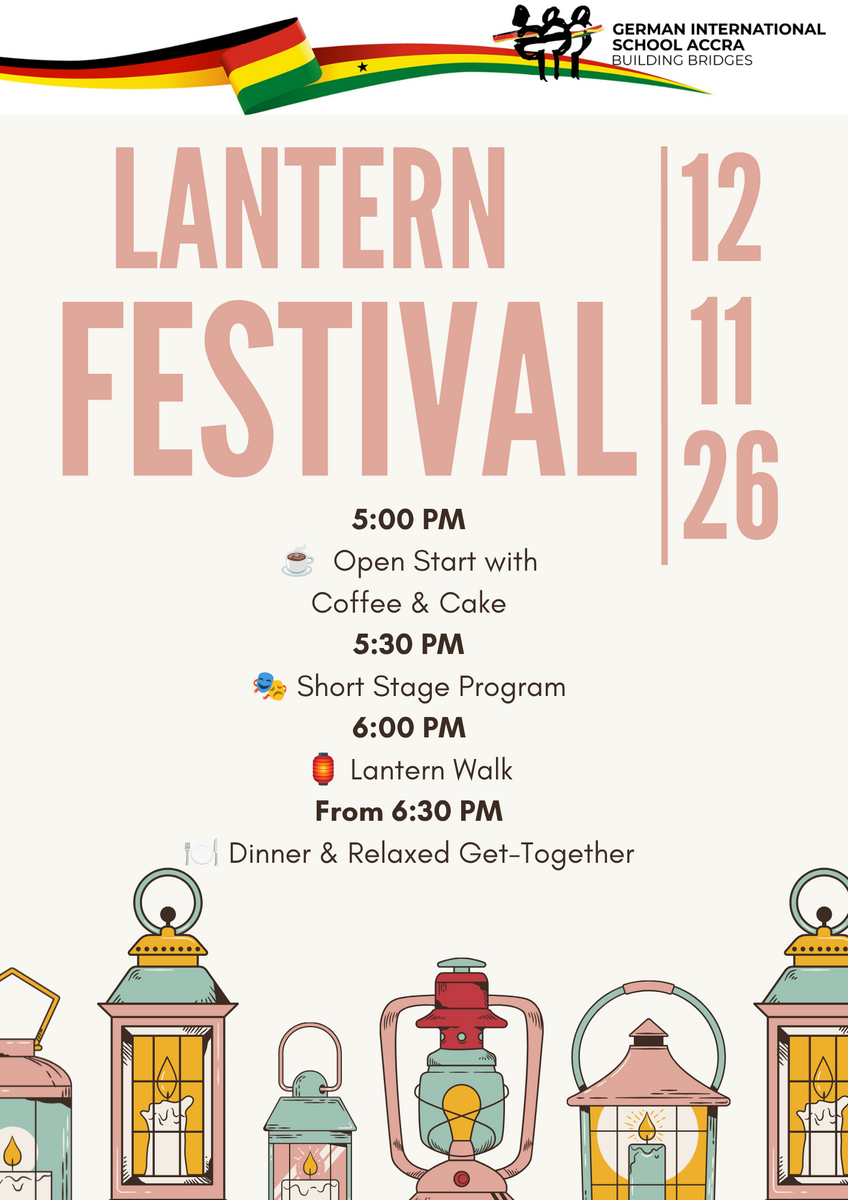
🏮 Thursday, 12 November 2026
Lantern Festival at GISA
🎭 Friday, 13 November 2026
Cultural Festival at the Goethe-Institut
🎄 Saturday, 28 November 2026
GISA Christmas Market
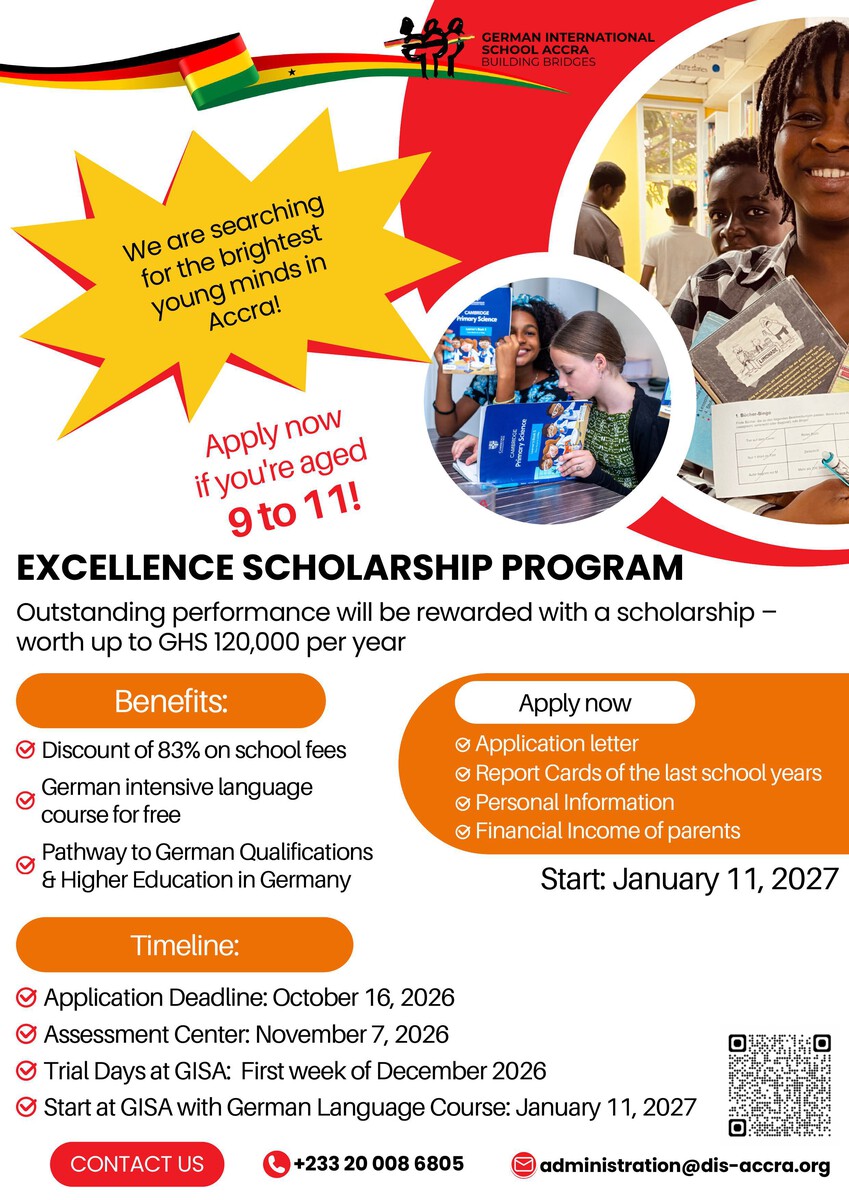
Excellence Scholarship Programme 2027
⚽Gerald Asamoah Football Academy
Lantern Festival
🇩🇪 German Language Day
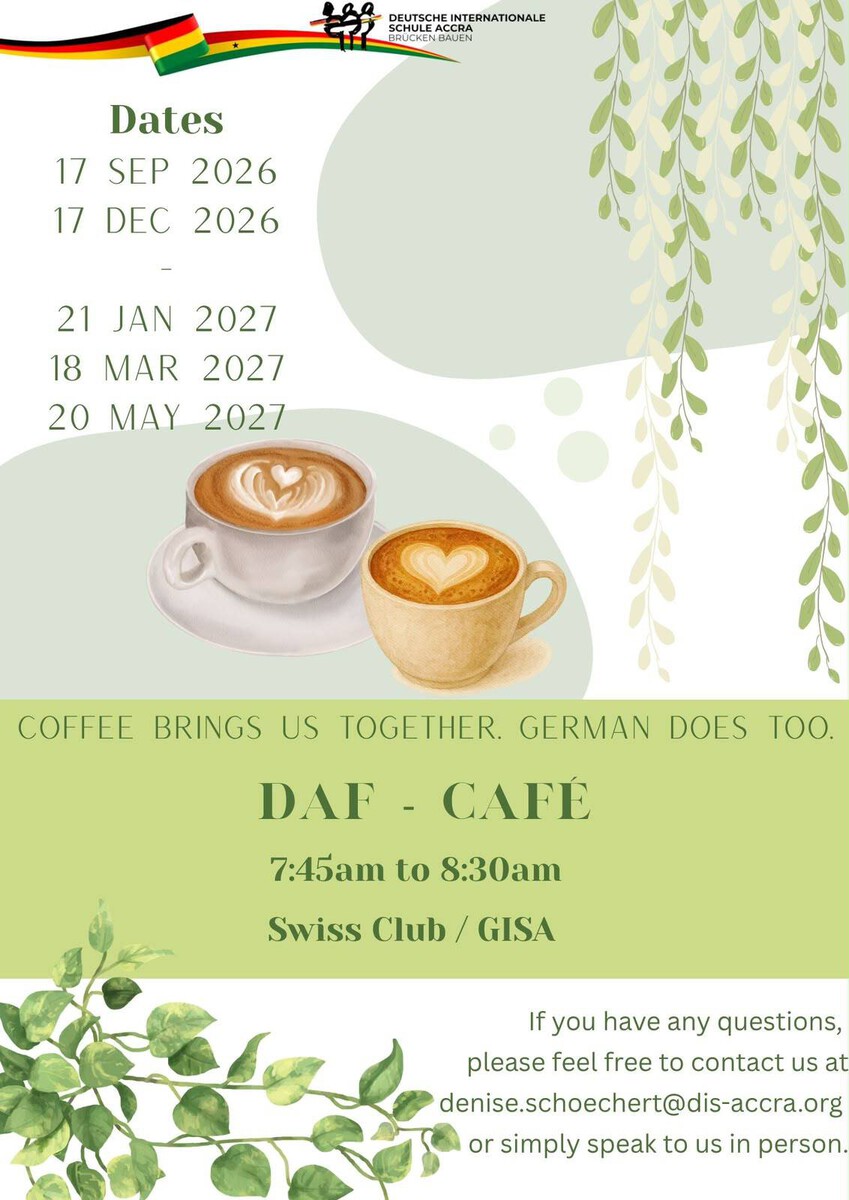
☕ DaF Café: Speaking German and Connecting Through Conversation
GISA Teen Club